
How to Successfully Serve Waiver Residents in Assisted Living

Serving residents who receive waivered services can enhance both resident outcomes and organizational sustainability, but only when done correctly. Facilities that are unprepared often experience compliance issues, documentation gaps, staff confusion, and financial risk. In contrast, facilities that serve waiver residents well create strong, person-centered environments, maintain regulatory compliance, and optimize reimbursement while supporting residents in living with dignity and choice.

Successfully serving waiver residents requires planning, operational alignment, staff education, and ongoing oversight. Below are key considerations and best practices to help assisted living providers build a sustainable waiver program.

Considerations

Assess Facility Readiness

Before accepting waiver residents, facilities must evaluate whether their operations align with HCBS (Home and Community-Based Services) settings requirements in addition to state-assisted living laws.

Key readiness questions include:

  • Does the physical environment support resident autonomy and choice?

Residents must have access to privacy, control over personal space, and access to food and beverages at all times.

  • Do current practices allow residents flexibility in schedules, activities, and services?

Resident must have the freedom to come and go, choose when to wake, eat, or receive services, and have visitors at times of their choosing. Rigid schedules that prioritize operational convenience over resident choice often create compliance concerns.

  • Are policies aligned with HCBS expectations for privacy, independence, and dignity?

Policies written for traditional assisted living models may unintentionally restrict waiver residents’ rights. Facilities should review policies related to supervision, safety, behavior management, and daily routines to ensure they support person-centered care.

If gaps are identified, operational changes may be necessary to remain compliant while serving waiver recipients.

Service Delivery - Individualize Services

Waiver residents require an individualized approach; there is no one-size-fits-all model.

Best practices include:

  • Respecting resident preferences for timing and method of service delivery
  • Accommodating individual routines and choices
  • Clearly documenting resident decisions and individualized supports

This individualized approach is a core expectation of waiver services and HCBS compliance.

Understand the Payment Structure

Waiver residents have separate revenue and distinct revenue streams, which must be clearly understood by leadership, billing staff, and clinical teams:

  • Room and board payments (private pay or housing support program)
  • Waived service payments

Facilities must track and manage each independently to ensure accuracy. Confusion between these two payment sources is one of the most common causes of billing errors, recoupments, and audit findings.

Clear internal systems should identify:
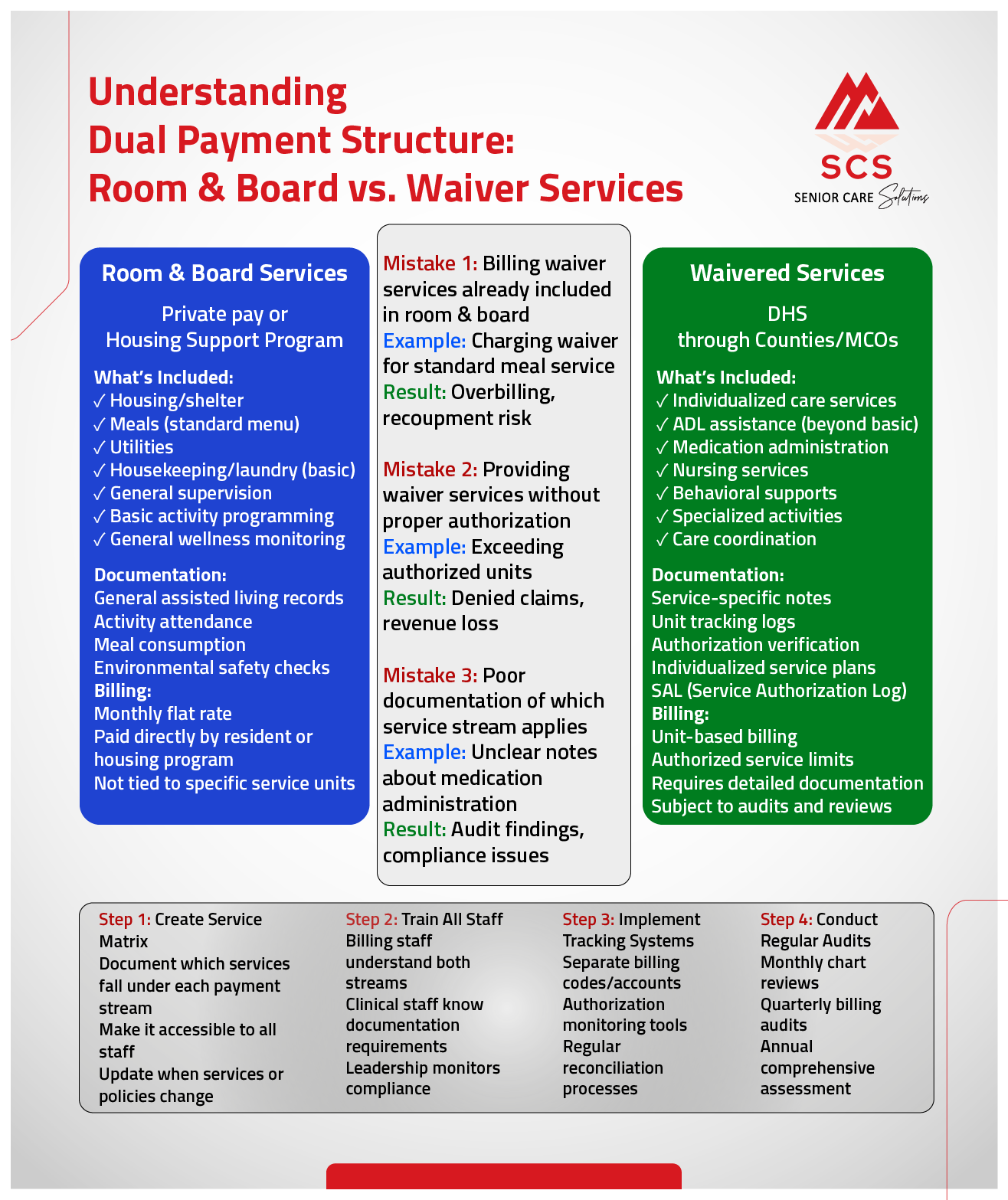
  • Which services are included in room and board
  • Which services are waiver-funded
  • How services are documented to support each payment source

Monitor Authorization Limits

Waiver services are authorized for a specific number of units based on assessed need. Facilities must actively manage these authorizations.

Facilities should:

  • Track authorized units
  • Request increases proactively when needs change
  • Avoid exceeding authorized service limits

Failure to manage authorizations can result in denied claims or recoupments.

Coordinate Effectively

Strong coordination with external case managers is critical to successful waiver service delivery. Case managers play a key role in authorizations, care planning, and oversight, but they often manage large caseloads and rely on timely, accurate information from facilities.

Facilities should:

  • Maintain regular communication with assigned case managers
  • Participate actively in care planning meetings
  • Promptly report changes in condition or service needs
  • Clearly distinguish between assisted living services and waiver services

Clear and consistent communication prevents service gaps, billing errors, and misunderstandings that can lead to compliance concerns.

Common Challenges and Practical Solutions

Confusion Between Room & Board and Waivered Services

Solutions include:

  • Developing a clear service matrix outlining service categories
  • Training staff on service distinctions and documentation expectations
  • Establishing consistent billing and review protocols
  • Documenting service categorization decisions clearly in the resident record

Documentation Burden

Solutions include:

  • Implement efficient documentation systems and workflows
  • Use technology where possible to streamline charting
  • Schedule dedicated documentation time
  • Conduct regular chart audits to identify gaps early

Coordinating with External Case Managers

Solutions include:

  • Establish regular communication schedules
  • Designate a waiver liaison within the facility
  • Use written follow-ups to support meetings
  • Clarify roles and responsibilities

Final Thoughts: 

Waivered services represent a significant opportunity for assisted living providers to expand their resident base, serve individuals with more complex needs, and fulfill the promise of community-based long-term care. However, successfully participating in waiver programs requires understanding unique requirements, planning, strong clinical oversight, staff education, and ongoing monitoring. When done correctly, it benefits residents, strengthens compliance, and supports financial sustainability.

Whether you're considering accepting your first waiver resident or seeking to improve existing waiver services, our team can provide the guidance and support you need for successful waiver program participation. Contact us today to discuss how waivered services can benefit your assisted living community and your residents.


Read More:

The 3 Biggest PDPM Reimbursement Opportunities Being Missed in Skilled Nursing

PDPM is a documentation and systems model. If it’s not documented correctly, it doesn’t count.Here are the most common reimbursement opportunities we see being missed in both PDPM State Case Mix and Medicare PDPM.

Spotting the Signs: Identifying and Responding to Changes in Resident Condition in ALFs

In assisted living, small changes can signal big issues. Recognizing subtle shifts in a resident’s condition can prevent complications and reduce hospital visits.

WHAT, WHEN and WHY of an Investigation

WHAT, WHEN and WHY of an Investigation: What Warrants an Investigation

Get Updated on the 2022 Legislative Changes to the Assisted Living License

This blog by Julie Dietz summarizes changes to Minnesota's assisted living laws. Key changes include updating resident rights regarding privacy and adding contact info for complaint reporting. The assisted living contract must now include termination grounds and the facility ID number.

Demystifying the Nursing Home Quality Reporting Program (QRP)

The Nursing Home QRP remains one of the most misunderstood CMS programs. Many facilities don’t realize that QRP is not about scoring high-it’s about reporting correctly and completely.

Section GG Mastery: The Key to Maximizing PDPM Reimbursement

Are you leaving money on the table because of incomplete or inaccurate Section GG coding?

Nursing Home VBP Demystified: What It Means and What You Can Do

The Skilled Nursing Facility Value-Based Purchasing (SNF VBP) Program is evolving — and fast. With new measures, shifting incentives, and increasing scrutiny, it’s time for nursing home leaders to move from confusion to clarity.

Why Ongoing Audits Are Essential for Regulatory Compliance in Nursing Homes

Compliance isn’t just about passing inspections—it’s about protecting residents and building trust. At Senior Care Solutions, we believe ongoing audits are the key to stronger compliance programs and better care.

Elopement Prevention in Skilled Nursing Facilities

Elopement is when a resident leaves a facility unsupervised which can result in serious harm and regulatory consequences. This issue is especially critical in SNFs, where many residents have cognitive impairments.

MN Case Mix Transition Plan to Section GG: A Strategic Roadmap for Senior Care Providers

As the October 1st transition approaches, MN nursing facilities must pivot from Section G to Section GG within the Minimum Data Set (MDS). This change isn’t just regulatory—it’s an opportunity to elevate documentation practices, team collaboration, and resident-centered care.

Survey-Ready Nursing: Using Policies and Procedures to Lead with Confidence

As a Director of Nursing (DON) in a skilled nursing facility, survey readiness is always on your radar. But what if your policies and procedures could be your secret weapon—not just for compliance, but for confidence.

The Importance of Effective Medication Administration Delegation in Assisted Living

Medication administration is a vital care component in assisted living facilities. To ensure residents receive their medications safely and on time, many facilities delegate this responsibility to unlicensed personnel (ULP). When done properly, delegation supports care continuity, efficiency, and resident well-being. However, improper delegation can lead to errors, non-compliance, and potential harm.

Reduce Immediate Jeopardy Tags With Appropriate Sling Use

High staff turnover and COVID-19 focus on infection control have led to more regulatory scrutiny in nursing homes. Inappropriate sling use is a growing concern. Facilities should ensure proper sling size, documented plans, staff training, and regular audits to prevent resident injuries.

Soothing Solutions: Creative Approaches to Pain Management in Nursing Homes

It is often a struggle for nursing homes to develop comprehensive pain management strategies.

Are Use of Electric Recliners Lifting You Toward a Deficiency?

A powered recliner may be considered a physical device which may be used by or for the care of a resident to promote, supplement or enhance resident’s function and/or safety. To ensure the residents’ safety, it is recommended to have this device included in your physical device assessment and ensure that it is appropriate for use and added to the plan of care.

Skilled Care Reimbursement: Recipe for Reimbursement

Blog Post by Michelle Stober RN, BSN, PHN, CEO Senior Care Solutions — The MDS assessment is your invoice for getting paid and unless you are occasionally checking the coding of your “invoices” you might be losing out on significant revenue.

The Benefits of Mock Surveys in Hospice

Mock surveys rehearse official inspections for hospices, pinpointing areas for improvement before real surveys. This helps staff prepare, identifies weaknesses, and boosts confidence.

Lores Consulting and Senior Care Solutions Proudly Announce their Strategic Partnership!

Senior Care Solutions (SCS) announces a partnership with Lores Consulting, expanding into Home Care and Hospice services. Lores Vlaminck, a retiring expert, joins forces with SCS's Michelle Stober. Both are passionate about quality care and aim to serve a wider client base. SCS is also affiliating with relevant industry groups in Minnesota.

Latest Updates on the MDH Assisted Living License Survey Trends

This blog post by Julie Dietz, a senior assisted living consultant, summarizes the most common deficiencies found in recent Minnesota assisted living facility inspections.

Is Your Coffee Too Hot?

This blog post warns about the burn risk from hot coffee in healthcare facilities. While coffee should ideally brew at 195°F, safe drinking temperature is much lower (155°F can burn in 1 second!). Lowering brewing temperature sacrifices flavor. The solution is to prevent spills with locked machines, air pots, travel mugs, etc. pen_spark

How Supplemental Nurses and Caregivers Can Help Your Assisted Living Staffing Plan

This blog post tackles healthcare staffing shortages. It highlights the use of supplemental staffing agencies and offers 3 key tips for facilities: 1) Verify agency accreditation, 2) Ensure staff meet facility requirements, and 3) Conduct thorough agency orientations. These steps help maintain quality care and compliance during staffing shortages.

Five Creative Ideas for Leaders to Help Keep Your Team Engaged

We offer tips for leaders to bring fun into the workplace. Ideas include holding meetings in new locations, having team lunches, taking walks, incorporating fun elements into stand-up meetings, and organizing monthly team-building activities. It emphasizes that having fun boosts morale and shows investment in employees.

Navigating the Holidays through Grief

The holidays can be tough for those grieving. This blog post offers tips for coping, like acknowledging your feelings, creating new traditions, and setting boundaries. It also suggests honoring your loved one and practicing self-care. Remember, grief is personal, so be kind to yourself.

The Heart of the Holidays: Meals in Assisted Living

Assisted living holiday meals are social events, but food safety is crucial. Staff should prioritize proper hygiene, temperature control, storage, and kitchen checks. Consider adaptations for resident needs while maintaining festive flavors. By following these tips, communities can celebrate safely and spread holiday cheer.

Nursing Home OSHA Ergonomics Program Law Effective 1/01/24

The 2023 Legislative Session passed a law effective January 1st , 2024 stating healthcare entities must have an ergonomics program (healthcare entity includes Nursing Homes).

Hospice Compliance and Oversight

A recent surge in concerns about hospice care quality led to stricter regulations. The Hospice Act of 2021 requires tighter oversight, improved quality metrics, and stronger patient protections.